
| Business Type | B2B |
|---|---|
| Product Stage | Pitch |
| My Role | Product Strategist and Pitch Designer |
| Cross Teams | Product owner and developers. |
| Time Span | 1 Week |
| Users | Company Managers and Approvers |
While building an Agentic AI based Product, we identified a critical opportunity: the traditional proposal form experience was outdated and inefficient. The parent platform had just introduced Agentic AI capabilities, creating a perfect moment to redesign the form from a passive data-entry screen into a dynamic, intelligent system that collaborated with users.
This feature study outlines how I designed a next-gen proposal form workflow that helped users write better proposals, faster; while boosting submission quality and approval rates.
Context / Problem
The existing form-based proposal system placed all the cognitive load on the user. Most users struggled to provide high-quality inputs, resulting in low approval rates and repeated back-and-forth with stakeholders.
At the same time, parent product had recently integrated Agentic AI, offering the potential to guide users contextually and conversationally. The problem wasn’t just usability, it was about enabling better thinking, articulation, and confidence at every step of the form.
My Role
As the Product Strategist and Pitch Designer, I owned the end-to-end design of this product Pitch, from identifying opportunity to delivering a tangible prototype. Things under my responsibility were:
- Defined the experience strategy aligned with business and product goals.
- Designed UX touchpoint, from interaction patterns to conversational flows.
- Collaborated with developers and product teams on feasibility and system logic.
Strategic Approach
My core strategy was to evolve the static form into a real-time AI analysis engine, a system that could assess inputs, coach users, and generate contextual proposals with minimal friction. I structured the experience into three stages:
- Guided input via intelligent questions
- Contextual deepening through AI follow-ups
- Proposal generation and agent-led continuity
This structure allowed users to gradually build context, improve their inputs, and receive help exactly when needed, without overwhelming them.
Execution
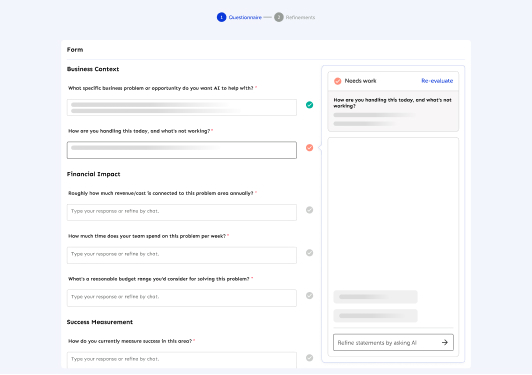
Step 1: Guided Questionnaires with Real-Time Feedback
Replaced standard input fields with dynamic question blocks. For each user response:
- The system in real-time rated the input as Needs Work, Good, or Excellent.
- Users received inline prompts to improve weak inputs.
- An embedded AI chat assistant allowed users to refine their answers conversationally- helping them reach “Excellent” in every section.
This coaching layer transformed the form into a collaborative thinking tool.

Step 2: Adaptive Questioning via Agentic AI
After the initial questionnaire:
- An AI agent reviewed user inputs and began asking custom follow-up questions, deepening context and connecting ideas.
- These prompts were personalized based on what the user wrote on step 1, making the system feel intelligent and responsive.
This created a second layer of clarity before proposal generation.

Step 3: Proposal Generation & Smart Agent Handoff
Based on all user inputs:
The AI agent compiled a complete proposal, intelligently structured and context-aware. The same agent was then assigned to the proposal as a follow up agent, capable of:
- Sending push notifications
- Following up on missing data
- Assisting with final approval coordination
This gave continuity to the user experience and kept the AI helpful even post-submission.

Outcome & Impact
- Functional Outcome: I delivered a working prototype and end-to-end UX flow that fulfilled both user needs and business objectives.
- Tangible Business Impact: The new flow improved submission speed and quality, boosted approval rates, and made the AI agent’s cross-checking a key differentiator in the process.
- User Experience Impact: Users no longer felt like they were filling a form- they felt guided, supported, and more confident. The conversational tone and real-time coaching elevated the process to feel like co-creation, not form submission.
Reflection
This Product feature was a reminder that AI is most impactful when it augments, not replaces, human effort. By embedding intelligence in the right moments- rating inputs, coaching users, and continuing support post-submission,
I was able to deliver a workflow that felt both smarter and more human.
I also learned the importance of pacing and layering AI interactions. Rather than overwhelming users with features.