| Office Type | Agency and in-house product |
|---|---|
| My Role | Design Ops Strategist |
| Teams | 3 - UX, UI and Graphics |
| Cross Teams | 2 - Product owners and Frontend developers |
| Time Span | 1.5 Years |
| Participants | 19 - Unique participation, Coworkers |
| Sprints | 6 - Sprint session with unique UX problems |
| Workshops | 11 - Workshops on design thinking |
| Category | Design Ops, Process Optimization, Cross-functional Collaboration |
| Focus | Elevating UX Maturity, Improving Team Efficiency |
In fast-growing design teams, inconsistency in process and communication can silently stall momentum. The Fuse Design Initiative (FDI) was born out of this realization, not as a training session, but as a catalyst for cultural and operational change.
What began as a simple experiment to align on frameworks became a structured, team-wide initiative that boosted UX maturity, empowered junior leadership, and created tangible improvements in efficiency and collaboration. This case study outlines how we used intentional design sprints and process thinking to reshape the way our team works and thinks.
Context / Problem
As the design team scaled across functions and verticals, we identified a critical challenge: inconsistent adoption of UX frameworks and a lack of shared mental models across our 16-member design team. This led to varying outcomes in product quality, misaligned processes, and duplicated efforts.
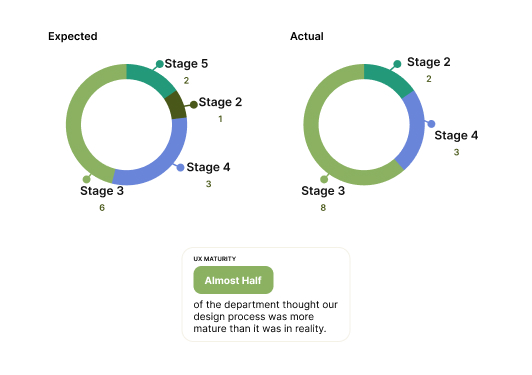
An initial UX maturity assessment using the Nielsen Norman Group (NN/g) framework placed our team between Level 2 (Limited) and Level 3 (Emergent). While individual designers were performing well, our collective design maturity and process cohesion needed a systemic push.
Key Signals:
- Disjointed communication and over-reliance on synchronous meetings.
- No standardized design problem-solving frameworks.
- Teams defaulting to instinct over process, limiting reproducibility.
- Slow feedback cycles, and inconsistent SOPs.
My Role
I led this initiative as a Design Ops Strategist, overseeing:
- The design and facilitation of the Fuse Design Initiative (FDI).
- Cross-functional alignment with teams when required.
- Framing the initiative as a team learning accelerator to improve both UX maturity and operational effectiveness.
- Mentoring teams through the Double Diamond framework and Design Thinking processes.
This was a leadership challenge that required process building, mentorship, facilitation, and systems thinking.
Strategic Approach
To create scalable impact, I designed FDI as a time-bounded, immersive design lab within our existing workflows.
Core Strategic Pillars:
- Use the Double Diamond framework as the goto methodology.
- Foster collaborative problem-solving in small, focused teams.
- Make the outcome visible, celebrated, and reflected upon.
- Document learnings to inform new SOPs and onboarding toolkits.
This approach wasn't just about teaching process, it was about creating a culture of shared design intelligence.
Execution
- Sessions: 6 sessions over 1.5 years, carefully integrated into office hours to avoid burnout.
- Time: Each session ran for 1 week in a 1 week sprint format.
- Teams: 3 cross-level groups, each with 3 designers.
- Task: Solve a real UX problem using Double Diamond framework + Design Thinking.
- Tools: Figma, Google meet.
- Final Day: Team presentations, critique sessions, and reflection.
- Unique Structure:
- Each team was self-steered with an assigned lead (rotational across sessions).
- In later sessions, junior designers were intentionally assigned leadership roles guiding senior designers through structured problem-solving. This flipped dynamic helped build confidence and leadership skills in emerging talent.
- Daily async check-ins replaced daily standup to reduce overhead.
- All process documentation and outputs were archived for team-wide access.
Outcome & Impact
UX Maturity Gains:
- Moved closer to Level 3 (Emergent) behaviors: consistent collaboration, research practices, and process fluency.
- Team-wide adoption of the Double Diamond framework as the goto methodology.
Impact:
Over the course of 1.5 years, the team facilitated multiple FDI sessions both sprints and workshops.
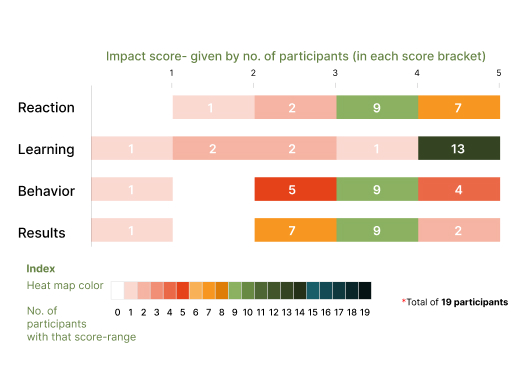
To gauge the impact in numbers we used a self assessment questionnaire following Kirkpatrick's framework: 4 levels of training evaluation. The metrics defined by this framework includes:
- Reactions: Trainee satisfaction where metrics are relating to relevancy, satisfaction and stress level.
- Learning: Acquisition of knowledge & skills mainly measuring confidence in application.
- Behavior: Application of learned material on the job to measure relevancy and frequency of usage.
- Results: Business result achieved by trainees mostly identifying source of efficiency and mindset changes.
Cultural Shift:
- Boosted confidence across levels, especially among junior designers.
- Peer mentorship became more common and fluid.
- Improved critique culture with shared vocabulary and decision frameworks.
Sessions have helped me unlock perspectives from a product standpoint. - Bibek KC (Senior UX)
I now plan requirements and its designs on a outcome basis in an iterative way. - Sudeksha Singh (Project manager)
These workshops helped me understand how to create value for the users as well as businesses while focusing on the user's needs as a priority. - Sujan Maharjan (Senior UX)
I now align ideas with user needs, feasibility, and business goals to ensure mutual value. - Anish Rajkarnikar (UX Designer)
Reflection
FDI reinforced a core leadership truth: great design teams aren't born from better designers alone, they’re shaped by the systems that support clarity, collaboration, and growth.
Key Learnings:
- Design maturity is behavior change, not knowledge alone. Embedding process into real work made adoption natural.
- Process accelerates teams. It’s not a bottleneck, it’s a booster.
- Rotating leadership empowered team members.
Next steps
With the successful introduction of FDIs in the design department, the next step forward was to to widening the scope of how we execute these sessions, this widening can be of two different types:
- Company-wide: Working with interrelated department teams to create end to end concepts from ideation to launch.
- Community-wide: Catering community events facilitated by FDI under Companies’ banner to promote design thinking and its challenges.